
AI Candidate Screening: How It Works and What It Costs

Short answer
AI candidate screening uses software to read a hiring brief, search a candidate pool, rank matches and surface evidence such as CVs and video intros, while people decide who to interview and hire. Measure the time it saves in a one-role pilot and test who it excludes, not just who it shortlists.
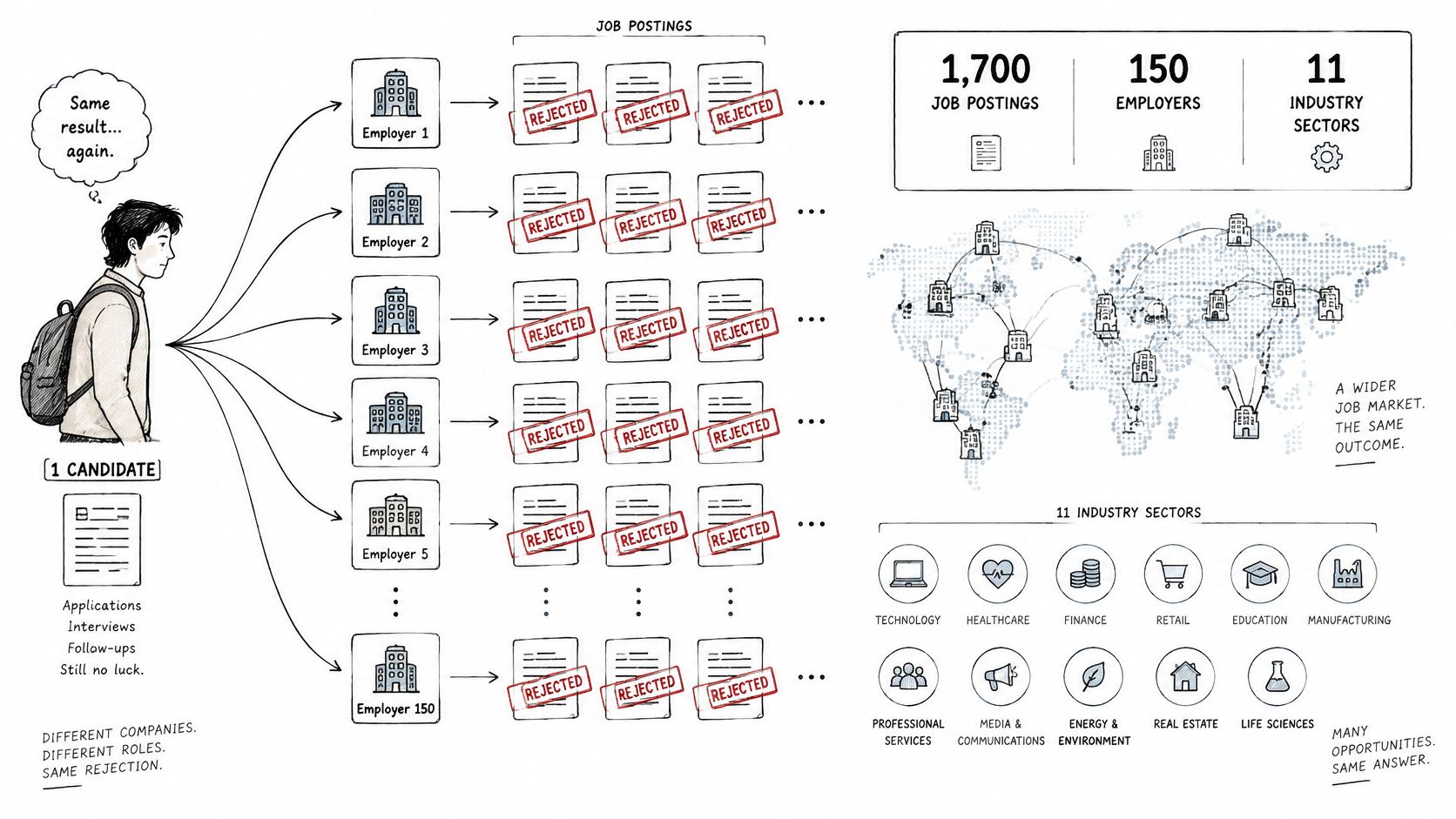
Ten percent of applicants who submitted four applications were rejected by every employer they applied to in a study of applications screened by the same algorithmic hiring vendor, according to Stanford's account of the findings. The risk isn't that software makes a poor recommendation. Employers using the same underlying model can repeatedly exclude the same candidates.
For US employers hiring remotely in Latin America, South Africa, the Philippines and beyond, AI candidate screening should be evaluated on more than speed. The useful questions are what the system measures, which qualified people it might overlook, and whether a hiring manager can identify and reverse a bad decision.
Table of Contents
- How AI Candidate Screening Works Stage by Stage
- How Much Time AI Screening Saves and Where It Stops
- What Recruiting Partners Charge and How Billing Differs
- Why Automated Rejections Can Repeat Across Employers
- Accessibility Checks for Video and Recorded Screening
- How to Run an Adverse Impact Test With the Four-Fifths Rule
- How to Vet an AI Screening Partner Before You Sign
- Run a One-Role Pilot Before You Commit
How AI Candidate Screening Works Stage by Stage
AI candidate screening assigns software the first-pass work of searching and sorting. A person still decides who gets interviewed and hired. It's the sourcing and review work before the first call, not a replacement for the entire recruiting process.
From a hiring brief to a shortlist
- Read the brief. The employer describes the role, country, language, time zone, monthly budget and must-have skills in plain language. Those requirements become search criteria, but the hiring manager must confirm which requirements are essential.
- Search the pool. Software queries a candidate database against those criteria. The employer separates requirements from preferences so that a preferred credential doesn't accidentally become an exclusion rule.
- Rank matches. Candidates appear in best-fit order. The reviewer should check the evidence behind each match rather than assuming that position in the list establishes ability.
- Review evidence. The employer examines the CV and video introduction for relevant experience and communication. Questions about collaboration or working style should become interview topics, not conclusions drawn from presentation alone.
- Book or pass. The employer schedules an interview or moves to another candidate. Interviews, reference checks and the offer remain human decisions.
In Hirespot's process, Spotter ranks the best matches for the job, best fit first. Each candidate's video intro and CV appear on one screen, where the employer can book an interview or select Not for me to see the next person.
Practical rule: A ranking determines review order. It shouldn't determine a candidate's fate without inspection.
A recruiter or hiring manager can pass on a candidate at any stage, but should record a job-related reason. Software narrows the field; conversations establish whether the candidate's experience and working approach suit the team.
Hirespot's explanation of what an AI recruiter does provides further context for this division of work. Hiring teams should map their current process onto these stages and mark every point where a person must make the call.
How Much Time AI Screening Saves and Where It Stops
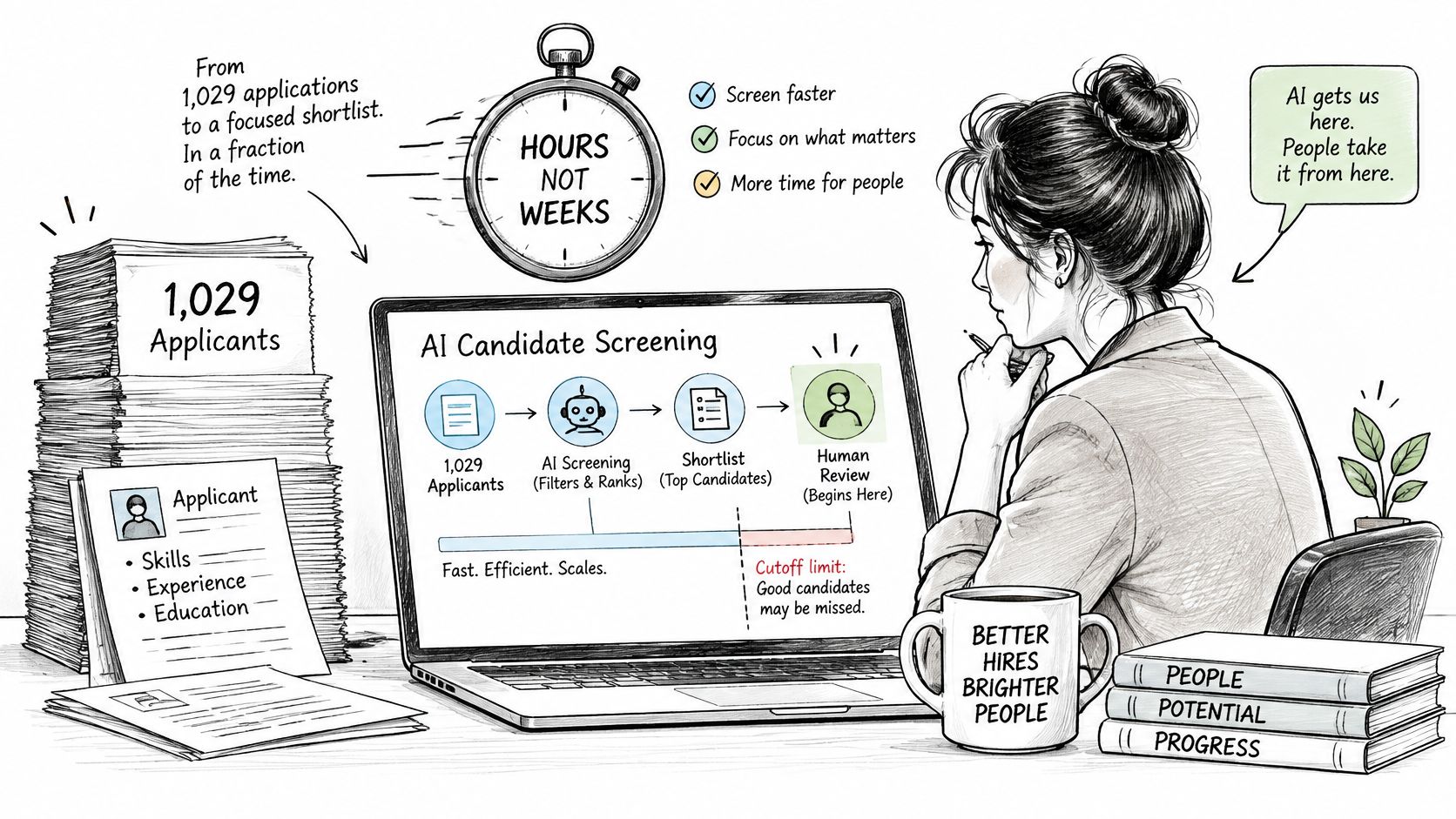
Manual screening effort fell by 80% in a 2023 study by Ujlayan, Bhattacharya and Sonakshi, which evaluated an AI screening framework using profiles from 1,029 applicants at an information-technology company. That's a result from one company, one dataset and one framework, not a universal productivity benchmark.
The framework extracted attributes from job descriptions and résumés, then compared them using similarity analysis. In everyday terms, it turned differently formatted documents into comparable information, reducing repetitive reading before a recruiter examined the strongest matches.
The screening step is where employers should measure the change.
Measure the local gain
- Establish the baseline. Count applicants per role and multiply by average minutes spent on first-pass review. Convert that total into hours.
- Run a pilot. Track actual screening time, including checking recommendations and correcting errors.
- Compare equivalent work. Subtract pilot screening hours from baseline hours for a comparable applicant volume.
- Include oversight. Don't exclude time spent reviewing questionable exclusions or fixing incorrectly parsed qualifications.
International hiring adds language requirements, working-hour overlap and unfamiliar credentials to the review task. Those are useful candidates for structured comparison, provided the employer checks how the system interprets them.
The decision about what to automate in recruiting should follow the measured bottleneck. Screening sets priorities; qualification checks and interviews remain human work.
What Recruiting Partners Charge and How Billing Differs
Billing models for recruiting partners
| Billing Model | How It Is Charged | Best Fit | What to Check |
|---|---|---|---|
| Contingency placement | Fee due only when a hire starts, usually a percentage of first-year salary | One hard-to-fill role | Guarantee period and replacement terms |
| Retained search | Upfront retainer, often paid in stages | Senior or specialist searches | Whether the retainer is refunded if the search stalls |
| Per-hire fee | Flat fee for each placed candidate | Repeat hires for the same role | Whether the fee covers screening or only placement |
| Subscription | Monthly or annual access to a platform | Ongoing volume hiring | Seat limits, usage caps and cancellation terms |
| Credit-based | Prepaid credits spent on searches or actions | Variable or occasional hiring | What one credit buys and whether credits expire |
The billing model shapes incentives as much as the headline price. A contingency arrangement ties payment to a completed hire. A retained search funds work before the outcome, making deliverables and progress checkpoints particularly important.
A flat per-hire fee can simplify budgeting for repeat roles, but the contract must define the service. Candidate sourcing, qualification checks, interview coordination and placement aren't interchangeable deliverables.
Compare the same hiring assignment
Subscriptions purchase access rather than a guaranteed hiring result. Credit-based arrangements require a clear definition of the action being purchased, including whether an unsuccessful search consumes credits.
Hiring managers should compare written proposals against the same role, candidate requirements and expected workload:
- Scope: Identify exactly who sources, screens, interviews and checks references.
- Exit terms: Check cancellation rights, unused balances and obligations if hiring pauses.
- Remedies: Establish what happens when a candidate leaves or a search stalls.
- Internal effort: Include the employer's remaining review and coordination work.
Published price points aren't a substitute for a written rate card. A seemingly cheaper arrangement, as the comparison of candidate sourcing tools shows, may leave more screening work with the employer, while an apparently broader service may exclude the checks the role requires.
An AI recruiting cost comparison should therefore start with the total cost of completing the same hiring assignment, not the smallest advertised payment. No numerical price comparison is reliable without matching scope and contract terms.
Why Automated Rejections Can Repeat Across Employers
Repeated rejection deserves investigation when employers share the same screening model. A candidate may appear to have received several independent assessments while meeting substantially the same evaluation logic each time.
The Stanford study covered in the opening is the clearest documented example. Its warning for hiring managers is correlated exclusion: a widely used system produces consistent recommendations across employers, and consistency is not the same thing as independence or fairness.
The study followed 3.4 million people who submitted 4 million applications to 1,700 job postings across 150 employers in 11 industry sectors, all screened by the same vendor.
What a shared model looks like in one rejection log
The pattern is testable inside a single employer's records, without waiting for a study or a complaint. Pull one role's rejection log for a quarter and sort the recorded reasons. When a large share of screened-out candidates fails on the same criterion, such as an employment-gap flag or a keyword threshold, a model-level rule is doing the deciding rather than a reviewer.
The signature sharpens further when that criterion removes nearly every candidate who shares a particular background while comparable candidates outside the group reach human review. At that point the employer has evidence of a systemic filter, and a vendor answer about "the algorithm's judgment" no longer explains the outcome.
Test exclusions, not just shortlisted candidates
An employer can't inspect another company's hiring decisions. It can examine whether its own process repeatedly excludes candidates whose qualifications warrant review.
- Keep rejection records. Log the candidate, role, screening stage, applied criterion and recorded reason.
- Assign a reviewer. Route borderline and potentially adverse decisions to a named person before closing them.
- Question shared infrastructure. Ask whether other clients use the same model, which components are shared and how the vendor validated them.
- Check outcomes regularly. Run selection-rate comparisons quarterly, by job family as well as across the overall process.
Reviewers should also inspect a sample of screened-out candidates. Examining only the shortlist cannot reveal qualified people who never reached it.
A clean-looking score isn't evidence of fairness. Employers need evidence about who advances, who doesn't, and why.
The practical distinction is between consistent processing and valid evaluation. Software can apply the same flawed criterion consistently across applications and employers. Hiring managers should require evidence that the criterion measures something the job needs.
Accessibility Checks for Video and Recorded Screening
An accidental rejection can begin with a requirement that seems harmless: a timed answer, an audio response or a camera-on introduction. The Americans with Disabilities Act requires reasonable accommodation in hiring, and a tool that scores well overall can still screen out a qualified applicant whose disability affects how they take the test.
The EEOC addressed this in May 2022 technical assistance on AI and disability, discussed in testimony at the agency's January 2023 hearing. The agency removed its AI guidance from its website in January 2025, but the ADA itself still applies (National Law Review). Employers should examine whether an assessment measures essential job functions or an unrelated barrier.
Separate capability from presentation
Remote screening requires particular care with speech differences, screen readers, neurodivergence, nonstandard interview settings and candidates who need extra time. Camera and connection limitations also shouldn't become unsupported judgments about professional ability.
A workable accessibility process includes:
- Defined signals: Document the job-relevant evidence being assessed. For customer support, assess whether an answer resolves the customer's problem, not whether the candidate maintains camera eye contact.
- Alternative formats: Offer written answers, an accessible document or a longer response window when appropriate.
- A clear request route: Explain how candidates request accommodations and identify who handles the request.
- Human review: Route accommodation-affected or uncertain cases to a reviewer rather than allowing an unexplained rejection.
Removing demographic fields isn't enough. Video, voice, writing style, employment gaps and response speed can still act as disability-related proxies.
Hirespot interviews are recorded with a transcript, and employer notes stay on the candidate's profile. Reviewers can use those records to examine job-relevant answer content, while checking transcript accuracy rather than treating transcription as unquestionable evidence.
An accent, assistive technology or unusual camera angle shouldn't be scored as weak communication without a defensible connection to the role.
How to Run an Adverse Impact Test With the Four-Fifths Rule
Employers remain responsible for selection effects when third-party software is involved. The EEOC's May 2023 technical assistance, withdrawn from the agency's site in January 2025, applied Title VII to AI-assisted selection procedures; Title VII and the Uniform Guidelines on Employee Selection Procedures still apply.
Calculate selection rates at each decision point
- Define the population. List applicants entering and advancing from each stage, for each group the employer can lawfully measure.
- Calculate selection rates. Divide selected applicants in each group by total applicants in that group.
- Identify the comparison rate. Find the highest group selection rate.
- Calculate the ratio. Divide each other group's selection rate by that highest rate.
- Flag substantial differences. Under the four-fifths rule in 29 CFR 1607.4(D), a ratio below 80% is generally treated as evidence of adverse impact and warrants review. For example, comparing 35% with 50% gives 35% ÷ 50% = 70%, below the threshold.
- Investigate the criterion. Check whether the flagged requirement is job-related and consistent with business necessity.
The infographic summarizes the calculation and its purpose.
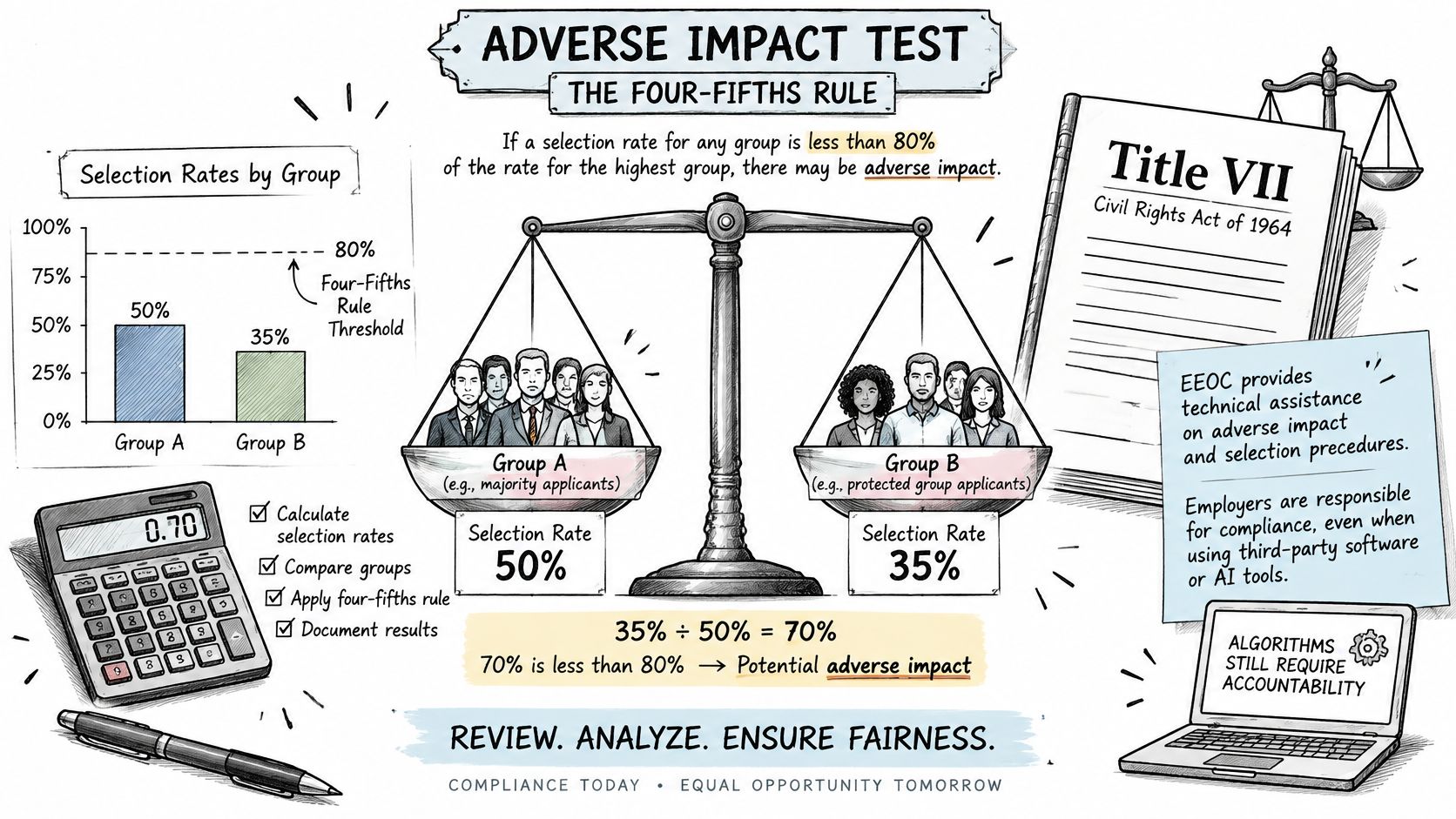
The rule is a screening test, not a legal verdict or safe harbor. Small samples can produce unstable ratios, and an acceptable overall result can conceal a problem within a particular role or screening stage.
Repeat the analysis by role and review period. Keep the criterion version, applicant counts, reviewer decisions and any changes together so the employer can reconstruct what happened.
After a flag, inspect the excluded applications, review the requirement and determine whether the model or hiring criteria need adjustment. Document the decision and evaluate subsequent outcomes rather than assuming the change fixed the problem.
How to Vet an AI Screening Partner Before You Sign
Partner vetting checklist
| Criterion | Question to Ask | Red Flag |
|---|---|---|
| Data handling | What candidate data is stored, for how long, and who can access it? | Vague answers or no deletion policy |
| Bias testing | Are selection rates measured by subgroup, and are results available? | No testing, or only one overall fairness score |
| Accommodations | How do candidates request alternative formats, and who reviews them? | No request process, or none for video screening |
| Human override | Can a person reverse a ranking or rejection? | Decisions are final with no review step |
| Outcome reporting | Are selection rates available by role, source market and language? | Reporting only at the account level |
| Cross-market testing | How are rankings tested across countries, languages and time-zone filters? | No evidence beyond a single benchmark |
| Pricing transparency | What is the full cost of a hire under the written terms? | Pricing given only on a call |
A partner should show its work, not just promise better matches. Procurement teams should put the same questions to each provider in writing and distinguish demonstrated controls from capabilities merely described in a sales conversation.
Check what aggregate reports conceal
Cross-market testing matters for employers recruiting across different credential systems and languages. A model can perform well on average and still rank one nationality or language group lower than another, which is why an overall score isn't enough.
A practical test holds skills and experience constant while varying nationality, language, location and name in synthetic profiles. Run these job-specific checks quarterly, then investigate differences in ranking exposure, translation handling and exclusion by budget or time-zone filters.
Human override should be demonstrated in the actual workflow. The buyer should see how a reviewer changes a decision and records the reason, not merely receive assurance that intervention is possible.
Outcome reporting should separate role, source market and language. A favorable account-wide summary can conceal a weak result in the hiring corridor that matters to the employer.
The International Labour Organization's discussion of algorithmic management recognizes legitimate employment uses of personal data while emphasizing safeguards. Buyers should require relevant collection, defined uses, controlled access and meaningful oversight.
References should come from employers hiring in comparable markets. Useful questions concern incorrect exclusions, accommodation handling and what happened when someone challenged a recommendation.
Run a One-Role Pilot Before You Commit
A pilot focused on one role produces something a demo cannot: a real shortlist whose decisions can be inspected. One role, written criteria, a recorded baseline. That is enough to see what the screening did.
Set the acceptance criteria before searching
- Choose a suitable role. An executive assistant, bookkeeper, customer support representative or sales representative can provide a clear starting point when requirements and applicant flow are well understood.
- Record the baseline. Track first-pass review hours and elapsed days to a usable shortlist.
- Write the criteria. Specify job-relevant requirements and the accommodation route before the search begins.
- Name human checkpoints. Assign responsibility for reviewing borderline exclusions.
- Inspect the first decisions. Look for the same rejection repeating across similar profiles, and check whether the available sample supports any conclusion at all.
- Decide whether to expand. Weigh saved effort against audit findings, correction work and the evidence supporting shortlisted candidates.
That fifth step matters more than it looks. A model that screens for many employers can apply the same judgment everywhere it runs, so a candidate rejected by the tool may be rejected again at the next company using it. A single-role pilot is the employer's first chance to see whether exclusions reflect this role's requirements or a fixed pattern the model carries from job to job.
Hirespot is an AI recruiter. Employers describe the role, country, language, time zone and budget to Spotter, which searches 400,000+ candidates and ranks the best matches. Each candidate's video intro and CV appear on one screen, and interviews are recorded with transcripts.
Hirespot also runs as an MCP server, so supported assistants such as Claude, ChatGPT and Cursor can search candidates for you. Searching through an assistant changes the interface. The employer's responsibility for the hiring decision stays the same.
Hirespot works with credits, and creating an account is free. Written usage terms and the employer's evaluation criteria should be settled before a pilot starts.
The expansion decision rests on a faster shortlist that the hiring manager can explain and defend.
Hirespot offers AI-assisted sourcing and sorting while employers retain responsibility for reviewing candidates and making hiring decisions. Employers can start a search on Hirespot; creating an account is free.
Questions
Can AI screening reject the same candidate at every employer?
Yes. A Stanford study of applications screened by one hiring vendor found that 10% of applicants who submitted four applications were rejected everywhere they applied. A shared model can repeat the same exclusion across employers, so review a sample of rejected candidates, not just the shortlist.
How do I test an AI screening tool for adverse impact?
Calculate the selection rate for each group at each stage, divide each rate by the highest group rate, and review any ratio below 80%, the four-fifths rule in 29 CFR 1607.4(D). Repeat the check by role and period, because small samples produce unstable ratios.
How much time does AI candidate screening save?
A 2023 study of 1,029 applicants at an IT company reported an 80% cut in manual screening effort, but that is one dataset. Measure your own baseline and pilot hours, including the time spent checking the tool’s recommendations.

Try Spotter on your next hire
Describe who you need and get your best matches from 400,000+ candidates.