
AI in Recruitment: Placement Fees Explained for Employers

Short answer
AI in recruitment changes how candidates are found, not what an agency contract obligates you to pay. A placement fee is the agreed percentage times the agreed compensation base, so define the base, trigger, guarantee and introduction window in writing, and decide upfront who owns a candidate that both an AI tool and an agency surfaced.

A US hiring manager has two quotes for the same remote role: one charges a percentage of base salary, the other asks for a fixed retainer. Neither makes the final cost obvious. Meanwhile, the team is evaluating AI sourcing, raising another question: could the company pay for candidate discovery and still owe an agency a placement fee?
For employers hiring in Latin America, South Africa, the Philippines and beyond, AI in recruitment changes how candidates are found, not what an existing contract obligates the employer to pay. The right comparison starts with the fee formula, then checks the clauses that can enlarge the invoice.
Table of Contents
- Placement Fee Models Compared
- How a Placement Fee Is Calculated
- Contract Terms That Move the Fee
- Where AI Tools Change the Fee Math
- Data and Compliance Clauses to Check
- Review Every Fee Term Before You Sign
Placement Fee Models Compared
The manager comparing those quotes shouldn't start with the headline price. The first question is who carries the search cost if nobody gets hired. A success-only arrangement and an upfront search commitment buy different things, even when their eventual totals look similar.
Contingency is the most common placement model: the employer pays a percentage of first-year base salary only when a hire is made. Retained search shifts more financial risk to the employer because the provider earns staged payments for conducting the search, whether or not it produces a hire.
Placement fee models and how they are billed
| Fee model | How the fee is calculated | Typical basis | When it is billed |
|---|---|---|---|
| Contingency | Percentage of first-year base salary, due only if a hire is made | Percentage stated in the quote | At offer acceptance or start date, per contract |
| Retained search | Set fee for the search, paid in stages | Stage amounts stated in the quote | Upfront, at shortlist and at hire |
| Flat fee | One agreed amount for the role | Fixed sum agreed before the search starts | At contract milestones |
| Hybrid (retainer plus success) | Smaller retainer, then a success fee on hire | Retainer plus success percentage from the quote | Retainer upfront, success fee at hire |
| Credit-based AI tool | Credits used per search or candidate match | Written unit price and credits consumed per action | Per the billing terms of the tool |
A flat fee makes the arithmetic easier, but it doesn't establish what counts as completed work. The agreement still needs to identify deliverables, cancellation rights and what happens if the employer changes the role.
For hybrid contracts, the employer should establish whether the retainer reduces the success fee or sits on top of it. For credit-based tools, the written terms should identify which actions consume credits, whether unused credits expire and whether repeating a search creates another charge. The AI recruiting cost guide provides a useful starting point for separating software spending from search-service charges.
Practical rule: Compare the cost of an unsuccessful search as carefully as the cost of a successful hire.
Contingency suits occasional hires. Retained or hybrid arrangements suit senior or urgent searches where an agency commits exclusive attention, while credit-based tools suit teams that handle screening themselves.
Every percentage, stage amount and credit price changes with the role, seniority and market. The signed wording, not the model's label, determines the commitment.
How a Placement Fee Is Calculated
Placement fee = agreed percentage × agreed compensation base. Both inputs need a written definition before any quote gets compared. Two agencies can quote the same percentage on different bases, and the wider base produces the bigger invoice.
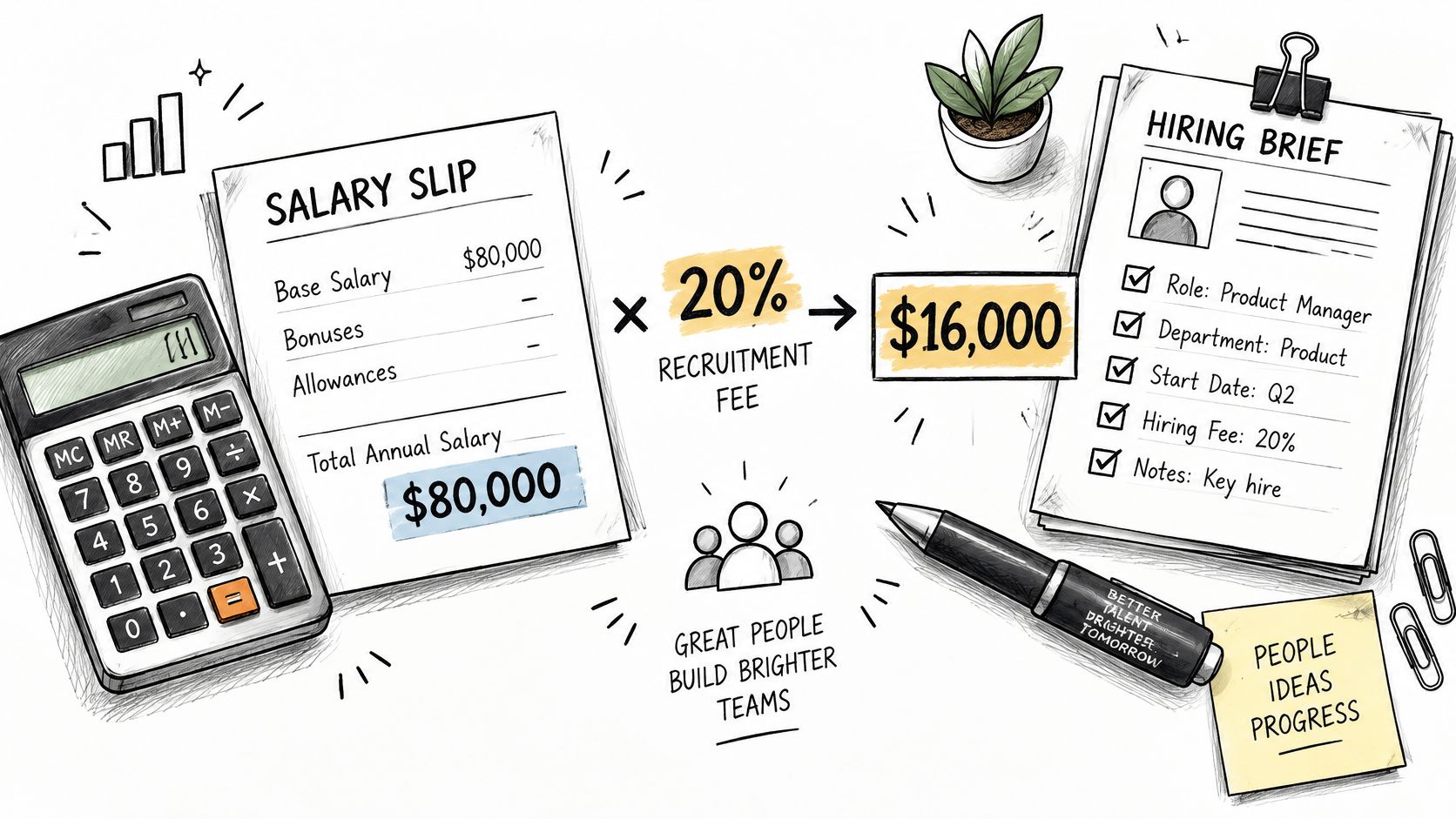
A company takes a contingency quote on a role with an $80,000 annual base salary and a 20% placement fee.
Calculate the base-only fee
The arithmetic is straightforward:
- Annual base salary: $80,000.
- Agreed fee: $80,000 × 20% = $16,000.
- Illustrative payment schedule: $16,000 ÷ three equal installments = approximately $5,333 per installment, with rounding reconciled on the final invoice.
Splitting the fee into installments changes cash flow, not the total obligation. A candidate who quits after the first installment can still leave the company liable for the remaining two, so payment timing and the point where the full fee becomes legally owed are separate questions.
Test what compensation includes
The offer attached to this quote adds a $10,000 signing bonus and an $8,000 annual bonus. When the contract charges on total compensation rather than base salary, the numbers move:
- Total compensation: $80,000 + $10,000 + $8,000 = $98,000.
- Total-compensation fee: $98,000 × 20% = $19,600.
- Additional charge: $19,600 − $16,000 = $3,600.
The entire $3,600 difference comes from one definitional choice. Negotiate whether a discretionary bonus counts at target value, at actual payout or not at all, and get equity and allowances treated explicitly. An undefined base lets the agency pick the widest reading at invoice time.
Separate replacement protection from cash recovery
The same agreement promises a 90-day replacement guarantee. A hire who leaves in week 10 triggers a free replacement search under that promise, provided the employer meets its conditions. The fee itself stays spent.
Under a twelve-month pro-rata refund, departure at month four leaves roughly two-thirds of the term unused. The employer recovers about two-thirds of the fee if the contract follows that formula, though the exact amount shifts with how the clause measures elapsed time and which departures qualify.
A replacement guarantee buys another search. A refund clause returns money. They aren't interchangeable.
Placement fees are generally structured per hire. Filling two roles can mean two fees even when both candidates emerge from a single search, so the contract should settle that situation before a second offer goes out.
Before comparing totals, confirm the compensation base, percentage, payment schedule and number of hires covered. Two quotes at the same headline rate produce different invoices the moment any of those four inputs changes.
Contract Terms That Move the Fee
A company interviews an agency-presented candidate, pauses the search, then hires that person directly six months later. The introduction, conversion or buyout wording decides whether a fee is still owed. Map the clause to the exact trigger for the fee: date of presentation, expiry of the introduction window and what counts as accepting a submission.
The strongest negotiation targets aren't always the percentage. A narrower fee base, a start-date trigger and a defined introduction window can make a quote more predictable without changing its headline rate.
Contract terms to confirm before signing
| Term | What to confirm | Red flag |
|---|---|---|
| Fee base | Whether the base is salary only or total compensation with bonus, equity and allowances | Base is undefined or includes unagreed compensation items |
| Trigger | Whether payment becomes due at signed offer, start date or after probation | Fee is due before the candidate starts, with no refund for a nonstarter |
| Guarantee period | Exact days and the refund or replacement route | No guarantee or an impractical claim process |
| Payment schedule | Installments tied to dated milestones on the invoice | Full payment due at invoice with no milestone |
| Conversion fee | Whether hiring after a trial or contractor period creates a fee, and for how long | Open-ended conversion obligation |
| Buyout or non-solicitation | Cost of hiring a presented candidate directly and the restriction's duration | Restriction covering anyone the agency has shown the employer |
| Currency and taxes | Invoice currency, VAT or withholding responsibility and exchange-rate method | Taxes or currency conversion left unstated |
Negotiate boundaries, not verbal assurances
For an introduction clause, request a written definition of valid introduction. An unsolicited name arriving in a general mailing should carry a different obligation than a candidate the employer accepts for an active vacancy. Counsel should also check whether restrictions reach affiliates, unrelated roles or candidates already in the employer's records, including people found through the employer's own sourcing. Where two channels produce the same person, the contract should assign ownership in advance; left silent, one hire can generate claims for two fees.
A conversion clause needs its own calculation method. The contract should state whether prior contractor payments offset the conversion charge and when the obligation expires. Left open, a trial engagement can produce a second recruiting bill on top of the first.
Keep worker classification separate
The label in the agreement should match how the worker is engaged in practice, since agencies and courts test status independently of the wording. The Department of Labor's compliance guide describes the rule in effect since March 11, 2024: a totality-of-the-relationship test using six economic-reality factors, with no single factor determinative. A February 2026 proposed rule would change that framework, so check its status before relying on it.
For cross-border engagements, counsel should assess the applicable local rules as well. A commercial conversion clause settles payment between businesses; classification follows the labor rules that govern the engagement.
Every negotiated definition should appear in the signed agreement or an incorporated amendment. Conversation-only assurances are harder to prove and enforce. Undefined terms deserve a signing hold, especially when they affect compensation, candidate ownership or the duration of a payment obligation.
Where AI Tools Change the Fee Math
US employer adoption of AI in recruitment rose from 4.9% in 2023 to 25.9% in 2025, according to iHire's 2025 State of Online Recruiting report, which surveyed 529 US employers. Employers combining AI sourcing with agency searches therefore need explicit rules against overlapping charges.
A candidate dashboard can organize the workflow, but the employer still needs to reconcile the commercial obligations behind it.
Separate the cost layers
The budget should distinguish software or credit charges, agency placement fees and internal screening and interview time. Paying for one doesn't automatically eliminate another. A cost per hire calculation puts all three layers into one comparable number.
In a direct-sourcing scenario, an employer finds candidates through an AI tool, conducts interviews and hires without agency involvement. The external recruiting charge is the tool usage, while the employer still contributes staff time. Hirespot is a self-serve AI recruiter requiring no recruiter intermediary: employers describe the role, country, language, time zone and budget to Spotter, which searches 400,000+ candidates and ranks the best matches; employers review matches and book interviews on their own schedule. Hirespot works with credits, and creating an account is free.
The distinction between discovery and hiring responsibility matters when evaluating what an AI recruiter does. Ranked results don't cancel obligations under a separately signed agency agreement.
Resolve duplicate introductions before interviews
In another scenario, an agency submits someone already found through an AI search. Both discovery routes exist, but the contract determines whether an agency fee attaches.
The employer should preserve search records, submission emails and prior-contact dates, then flag duplicates before progressing the candidate. Negotiating an exclusion after offer acceptance is a weaker position.
Before authorizing parallel sourcing, the employer should ask the agency:
- Overlap: Can submitted candidates also appear in AI tool results?
- Evidence: What records establish a qualifying introduction?
- Prior contact: Does a fee apply when the employer already met the candidate?
Data and Compliance Clauses to Check
Vietnam and Italy illustrate why a generic global privacy promise isn't enough. As explained in Employment Horizons' AI and data privacy analysis, Vietnam's Personal Data Protection Law took effect on January 1, 2026, generally requiring voluntary, informed and specific consent for prospective-employee data processing and deletion of unsuccessful candidates' data unless they agree otherwise; Italy's rules require notice of AI use in recruitment and disclosure of the logic, criteria and purposes of employment-related AI decisions.
Those examples aren't substitutes for advice on Latin American, South African or Philippine requirements. They show why the employer needs a country-specific operating plan rather than assuming its US hiring notice covers everyone.
Put data responsibilities into the agreement
A remote search can create CVs, video introductions, recordings, transcripts and evaluation notes across several countries. Storage location, access location and candidate location should all be mapped before the team starts collecting material.
The agreement should answer this numbered checklist:
Who is responsible for cross-border transfers, the employer or the vendor? Identify who determines the transfer arrangements, documents the applicable safeguards and manages subprocessors. A vague statement that both parties comply with law doesn't allocate the work.
Do recordings, transcripts and written notes have separate retention periods? Require a schedule for each record type, including unsuccessful applications and backup copies. Keeping every artifact indefinitely shouldn't be the default.
How is consent handled when the AI system is reached through a third-party platform? Identify who delivers the notice, captures the candidate's response and records the permitted purposes. An additional interface shouldn't obscure the underlying processing responsibilities.
How does a candidate request deletion or an explanation of a decision? Name the receiving contact, the escalation owner and the human reviewer. The process should reach the records and people needed to act, not end at a support inbox.
Inspect the interview record
At Hirespot, interviews are recorded with a transcript, and the employer's notes stay on the candidate's profile. The contract review should establish where those files are stored, who can open them and how long they're retained; those details shouldn't be assumed.
The Hirespot privacy policy belongs in the review materials, alongside any applicable contractual data terms. Access permissions should also distinguish hiring managers, interviewers and administrative users rather than treating the whole company as one audience.
Contract standard: Retention, deletion, access and transfer commitments belong in an enforceable agreement, not only on a privacy page the vendor can change.
Review Every Fee Term Before You Sign
Work through this sequence before authorizing the search or accepting billable candidate submissions:
Put every quoted figure in writing. Convert each verbal number into a line item: the fee basis, the amount and the event that earns it. A retainer discussed as refundable stays refundable only if the contract says so.
Recompute the fee on your real offer. Have the agency state in writing whether the percentage applies to base salary, guaranteed cash or total compensation, then run the math on the package you plan to offer. That figure becomes your budget line.
Price the early-departure scenario. Calculate the dollar recovery for a departure you consider plausible and identify the remedy attached to it. A replacement search has value only if you still have a vacancy to fill, so confirm whether cash back is on the table at all.
Build an invoice calendar. Map each installment to the event that authorizes it and its payment deadline, then total the committed spend. Paying in stages still obligates the full balance once the placement lands, so schedule the cash accordingly.
Write down the conversion and buyout terms. Record expiration dates and the price of hiring a candidate outside the agreed window. If your own sourcing already reached a candidate, get that person excluded in writing before the search starts; an unlisted prior contact gets billed at the full fee.
Move data commitments into the signed agreement. Transfer, retention, access and deletion responsibilities belong in the contract or an incorporated exhibit. Verbal assurances carry no weight once candidate records start moving, so attach the terms and name the internal owner who will monitor them.
Request adverse-impact evaluation details. The EEOC's May 18, 2023 technical assistance, withdrawn from the agency's site in January 2025, recommended asking outside AI selection providers what steps they've taken to evaluate adverse impact, as explained in Littler's analysis of the EEOC guidance. Get the answer in writing; a general fairness claim says nothing about how the tool was evaluated.
Obtain legal sign-off
Counsel should review the final contract, including negotiated amendments and incorporated policies. The employer should retain the signed version alongside the fee calculation and candidate-source records.
Hirespot offers AI-assisted candidate sourcing, video introductions and CVs, with recorded interviews and transcripts; its MCP server also supports candidate searches through Claude, ChatGPT and Cursor. Employers comparing direct sourcing with placement-fee arrangements can start a search on Hirespot; creating an account is free.
Questions
How is a recruiter placement fee calculated?
Multiply the agreed percentage by the agreed compensation base. At 20% of an $80,000 base salary the fee is $16,000; if the contract uses total compensation including a $10,000 signing bonus and an $8,000 annual bonus, the same 20% becomes $19,600.
Do I owe an agency a fee if I found the candidate with an AI tool?
It depends on the contract’s introduction clause. Keep search records and prior-contact dates, flag duplicates before interviews, and get candidates you already found excluded in writing before the agency search starts.
What is the difference between a replacement guarantee and a refund?
A replacement guarantee gives you another search if the hire leaves within the guarantee period, and the fee stays spent. A refund clause returns money, often pro rata, so the two are not interchangeable.

Try Spotter on your next hire
Describe who you need and get your best matches from 400,000+ candidates.