
How to Hire an Executive Assistant: Steps, Tests and Costs

Short answer
To hire an executive assistant, write a one-page brief with hours, decision rights, systems access and escalation triggers, set the budget against that scope, shortlist five to eight candidates who meet the essentials, score finalists on one rubric with a paid 60 to 90 minute work sample, and confirm the terms in a written offer.

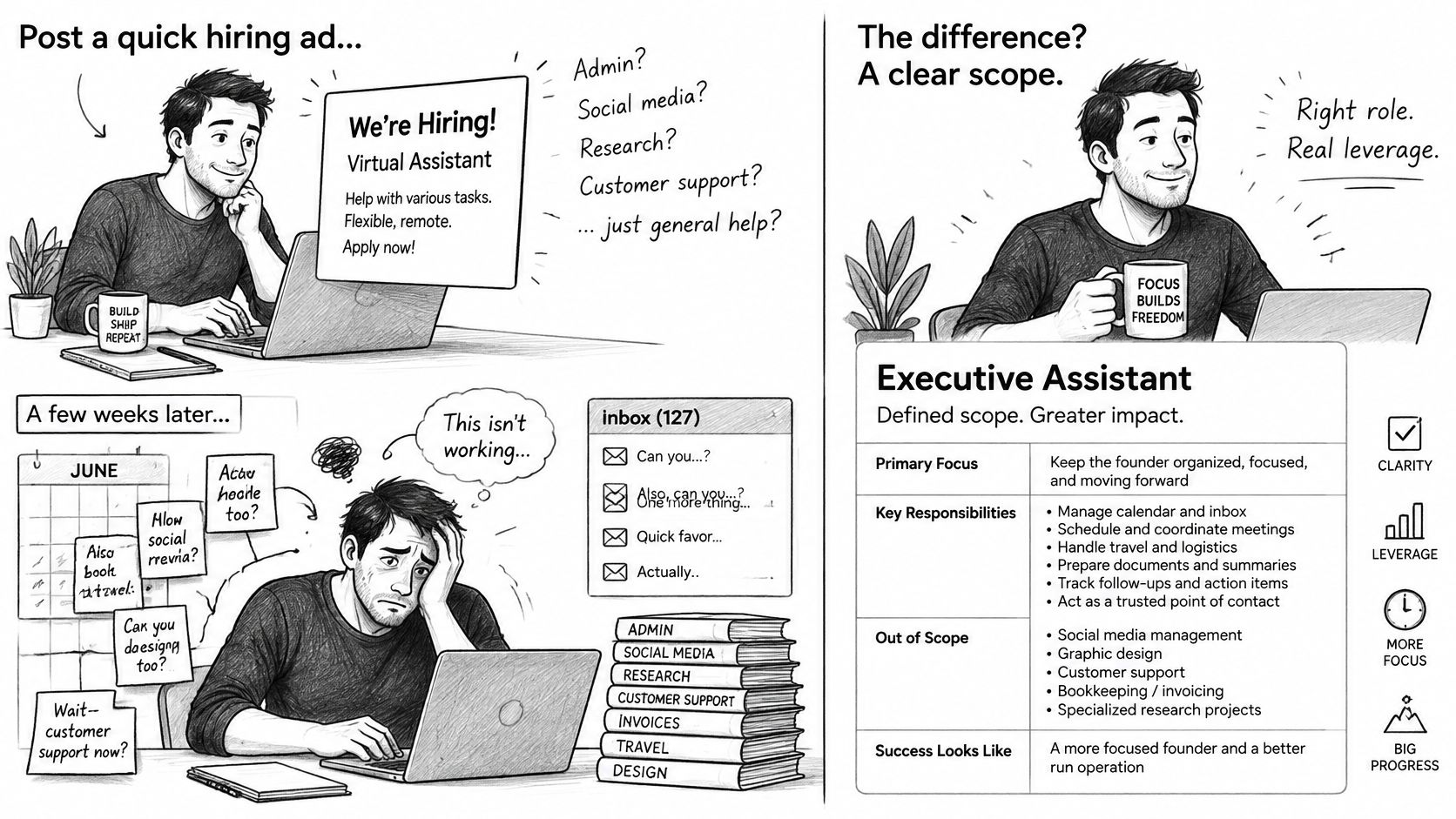
A founder's calendar is packed, the inbox keeps growing, and every “quick” request still lands on the founder's desk. A generic virtual-assistant posting can bring applicants, but it won't tell the hiring manager whether someone can protect priorities, make sound decisions with incomplete information, and know when to escalate.
Hiring an executive assistant works best as an operating-design problem. Before the search begins, the employer needs to decide what the assistant will own, what they can decide independently, and what requires the executive's approval.
Table of Contents
- Define the Role, Scope and Budget First
- Get Classification and Data Handling Right
- Source and Shortlist Remote Candidates
- Score Finalists With a Paid Work Sample and One Rubric
- Make the Offer and Confirm the Hire
Define the Role, Scope and Budget First
Start with the work, not the title. A vague scope produces a vague search: the founder ends up re-briefing the hire for weeks because nobody agreed who could move meetings, answer routine messages, or approve travel. The role was too vague to attract the right person, and no strong candidate can fix a scope that was never set. The scope determines the candidate profile, the authority to delegate, and the budget.
| Scope level | Typical responsibilities | Define before sourcing |
|---|---|---|
| Inbox and calendar support | Scheduling, travel bookings, routine correspondence, meeting notes | Working hours, response-time standard, calendar access |
| Executive operations | Reports, board material preparation, stakeholder follow-up, vendor coordination | Spending limits, decision rights, escalation rules |
| Chief-of-staff style | Cross-team projects, hiring coordination, sensitive communications, operating reviews | Authority limits, confidentiality scope, time-zone overlap |
Each level changes what good judgment looks like. An inbox and calendar hire needs clear scheduling boundaries and access. An executive operations hire needs authority to follow up across teams and handle defined spending. A chief-of-staff-style role needs a sharper line between coordination and executive decision-making. Without that line, the assistant either waits for approval on routine work or makes calls the executive never delegated. Write the escalation triggers in concrete terms: a moved board meeting, a supplier dispute, a message from an investor.
Write a one-page operating brief
The brief should answer six practical questions before any candidate is sourced:
- Working hours and overlap: Which hours must align with the executive's time zone?
- Response standard: For example, should routine messages receive a reply within two hours during overlap?
- Systems access: Which calendars, inboxes, documents, and task systems will the assistant use?
- Decision rights: Can the assistant reschedule meetings or approve routine spending within a limit?
- Confidentiality: Which personnel, financial, customer, or board matters will be accessible?
- Escalation triggers: What changes, risks, or requests must go directly to the executive?
Then set the budget against the actual scope. The Bureau of Labor Statistics puts the median annual wage for executive secretaries and executive administrative assistants at $76,590 in May 2025. Treat that as a U.S. reference point when pricing a remote role: it shows why work involving executive judgment, confidentiality, complex scheduling, or sensitive communications warrants pricing above entry-level general administration. For the sourcing side of the same equation, a breakdown of AI recruiting costs is a useful companion read.
Set experience requirements against the actual work: the BLS occupational factsheet reports that prior experience was required for 87.2% of U.S. executive secretary and executive administrative assistant roles in 2025. A high-trust operations role may warrant substantial experience; a tightly defined support role may not.
The brief passes its final test when a stranger can read it and tell what the assistant decides alone.
Get Classification and Data Handling Right
A contractor agreement doesn't settle whether a remote assistant is legally an independent contractor. The actual working relationship matters, especially when the employer expects set hours, close direction, and ongoing support.
The U.S. Department of Labor's classification guide says the FLSA analysis uses six economic-reality factors. They are the worker's opportunity for profit or loss through managerial skill, the investments made by the worker and employer, the relationship's permanence, the employer's control, whether the work is integral to the business, and the worker's skill and initiative. No single factor decides the outcome; the relationship is considered as a whole. A February 2026 proposed rule would change this framework, so confirm its status before relying on it.
Consider a founder who sets fixed hours, directs daily tasks, supplies the equipment, and relies on the assistant for an ongoing core function. A contractor label may not resolve the classification question. The employer should get a careful review before committing to that arrangement, rather than treating the contract template as the answer. State requirements and the rules in the assistant's country may apply separately.
Tell candidates how their information is handled
A remote search may involve CVs, video introductions, interview recordings, transcripts, and interviewer notes. Candidate notices should explain the purpose of collecting and retaining that information, who can access it, and how long it will be kept. The European Data Protection Board's applicant-data guidance describes consent and legitimate interest as possible legal bases for storing CVs, and says applicants must be told that their data will be stored and why.
Before drafting an agreement, document the role's scope, expected duration, equipment responsibilities, payment arrangement, and supervision model. Employers hiring across borders should also get local legal and tax advice in the candidate's country. U.S. rules don't replace the employment and privacy requirements that may apply there.
Source and Shortlist Remote Candidates
The executive assistant title covers very different jobs. Sourcing by title alone can produce a pile of CVs from candidates who don't share the required working hours, language, or decision-making experience. A clear brief gives the search useful boundaries.
- Write must-haves in plain language. Name the working-language level, time-zone overlap, essential tools, and experience requirements that follow from the role. Calendar software can often be learned; judgment around confidential requests takes more evidence.
- Set a monthly budget range. A range helps distinguish a support-focused role from a senior operations remit before interviews begin.
- Name a country or region where location matters. Employers can specify a target such as an executive assistant in South Africa or the Philippines, while keeping the overlap window central to the decision.
- Describe the role to Spotter in a chat. Hirespot is an AI recruiter: the employer describes the role, country, language, budget, and time zone in plain words, and Spotter searches 400,000+ candidates around the world and ranks the best matches. It can filter by region, language, time zone, budget, skills, tools and industry.
- Review the ranked matches in order. Each candidate's CV and video introduction appear on one screen, so the hiring manager can assess written experience and communication before deciding whether to book an interview or move on.
A country filter is useful only when it supports the role's actual constraints. If the executive needs coverage during a particular workday, overlap is more important than choosing a country name in isolation. Similarly, rejecting someone for a tool that can be learned quickly may screen out a strong assistant for the wrong reason. For remote hires specifically, the remote executive assistant guide maps a 9-to-5 Eastern day onto Bogotá, Mexico City, Manila and Johannesburg time and lays out a three-week handover.
Candidate sourcing gets easier to manage when the requirements are explicit; this guide to candidate sourcing tools offers additional context on defining a search. A useful first shortlist is five to eight candidates who meet the essential requirements and merit the same structured interview.
Score Finalists With a Paid Work Sample and One Rubric
A polished conversation can make a candidate seem capable without showing how they handle competing priorities. Structure closes that gap. An employment-interview meta-analysis covering 245 validity coefficients and 86,311 participants found corrected validity of about 0.44 for structured interviews and 0.33 for unstructured interviews, according to the meta-analysis by McDaniel, Whetzel, Schmidt and Maurer (1994) in the Journal of Applied Psychology. Later reanalyses estimate lower validities for both formats, but structured interviews still come out ahead.
Give every finalist the same prompts, evaluation order, and scoring anchors. Consistent structure makes the evidence easier to compare and reduces the chance that rapport outweighs job performance. It also surfaces the quality that matters most in an executive assistant: judgment about what to own, what to decide, and what to escalate.
Use the same sequence for every finalist
- Review application evidence. Look for examples of calendar ownership, written communication, prioritization, confidentiality, meeting preparation, travel logistics, and collaboration across time zones. A tool list proves familiarity; judgment shows up in how the candidate describes past decisions.
- Run a structured interview. A 20- to 30-minute conversation can include: "Describe a time you protected an executive from low-value interruptions while preserving stakeholder trust." Score the situation, action, result, judgment, and supporting evidence separately.
- Give a paid simulation. Set aside 60 to 90 minutes for a realistic exercise: resolve a conflicting calendar, draft a concise executive email, rank six incoming requests, respond to a last-minute change, and handle confidential details alongside incomplete instructions. Ask the candidate to document assumptions, name which requests they would resolve alone, and flag what they would escalate.
- Check references with behavioral questions. Ask about missed commitments, confidentiality, responses to ambiguity, and the level of supervision required. A general question about whether someone would be rehired gives less useful detail.
- Compare signals before deciding. The interview, simulation, and references should tell a consistent story, or clarify where the evidence differs.
The U.S. Office of Personnel Management's work-sample guidance describes simulations as representative of job tasks. Representative is still partial. No single exercise captures months of ambiguous priorities, and work-sample scores predict only part of later job performance. Treat the result as one important signal in the full evidence set.
Score what the exercise shows
Use one rubric for every finalist. The weights below total 100 points, and each score should include written evidence. Two raters should score independently before discussing differences.
| Criterion | Weight | What a strong answer shows |
|---|---|---|
| Work sample accuracy and judgment | 35 | Correct outputs and documented assumptions |
| Prioritization | 20 | Ranked order of six requests with a reason for each |
| Communication | 15 | Concise executive email and clear written updates |
| Reliability and follow-through | 15 | Commitments tracked, deadlines confirmed, gaps flagged early |
| Confidentiality and tool fluency | 15 | Sensitive data handled correctly and calendar and task tools used well |
A strong candidate resolves the calendar conflict, explains the assumptions behind the choice, and flags the one decision that belongs to the executive. A weak candidate schedules everything without asking which commitment matters most. The exercise measures judgment under ambiguity.
Hirespot covers the sourcing side: Spotter does the searching and sorting, so more of the hiring effort can go to the structured interview and paid simulation that test the work itself. For a related walkthrough of support roles, see this guide to hiring a virtual assistant.
Make the Offer and Confirm the Hire
Choose the finalist with the strongest evidence, not the strongest rapport. The decision should follow the scores, written examples, simulation performance, and references gathered during the process. A polished communicator who struggles to prioritize should not pass on rapport alone.

Confirm the decision and make expectations explicit
Total each finalist's rubric score and read the written evidence behind every rating. Check whether the work sample and references support what the candidate said in the interview. If those signals conflict, resolve the discrepancy before selecting anyone, because a gap between a strong interview and a weak work sample is exactly the judgment problem this hire cannot afford.
Next, confirm the appropriate worker classification before preparing the agreement. Then send a written offer that states the start date, working hours, required overlap, response-time standard, decision rights, and escalation rules. The last three items are where remote assistant arrangements tend to drift, so put them in writing rather than assuming they were understood. Keep a backup finalist warm for two weeks in case the first choice declines.
The hiring process should feel clear to the candidate as well as the employer. In Hirespot, you describe who you need, review your best matches and book interviews from the candidate's profile. Interviews are recorded with a transcript and notes, which gives the hiring team material to evaluate against its criteria.
Use the first month to test the operating agreement
The 30-day onboarding scorecard should measure the work the assistant was hired to own, not whether the executive likes their communication style. Track whether the assistant meets the response standard, prioritizes real requests consistently, protects sensitive information, follows through, and escalates the right decisions. Each item maps back to a term in the offer, which makes the scorecard a check on the agreement rather than a personality review.
At the end of the first month, compare the results with the original role brief. If the assistant escalates routine matters too often, clarify decision rights; if important issues reach the executive late, tighten the escalation triggers. A miss on response time or follow-through points to a workload or expectation problem, while a miss on escalation points to the operating design itself.
Hirespot helps employers source and review remote executive-assistant candidates by role, country, language, time zone, and budget, with ranked matches that include a video introduction and CV. Start a search on Hirespot; creating an account is free.
Questions
How much does an executive assistant cost in the US?
The Bureau of Labor Statistics puts the median annual wage for executive secretaries and executive administrative assistants at $76,590 in May 2025. Remote rates vary by country, experience and hours, so set a monthly ceiling and compare the rates on your ranked matches.
What should an executive assistant work sample include?
A 60 to 90 minute paid exercise: resolve a calendar conflict, draft a concise executive email, rank six incoming requests, handle a last-minute change and mark which decisions they would escalate. Score it on one rubric, with two raters scoring independently.
Should an executive assistant be a contractor or an employee?
It depends on the real working relationship. Set hours, close direction, company equipment and ongoing core work point toward employment under the Department of Labor’s economic-reality factors, so get a classification review and local advice in the assistant’s country.

Try Spotter on your next hire
Describe who you need and get your best matches from 400,000+ candidates.